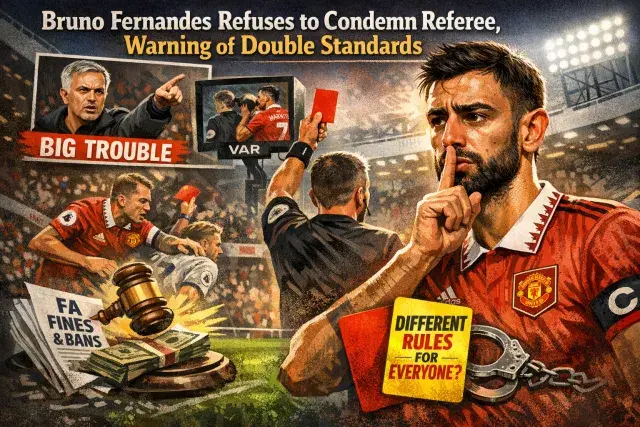
Bruno Fernandes Refuses to Condemn Referee, Warning of Double Standards
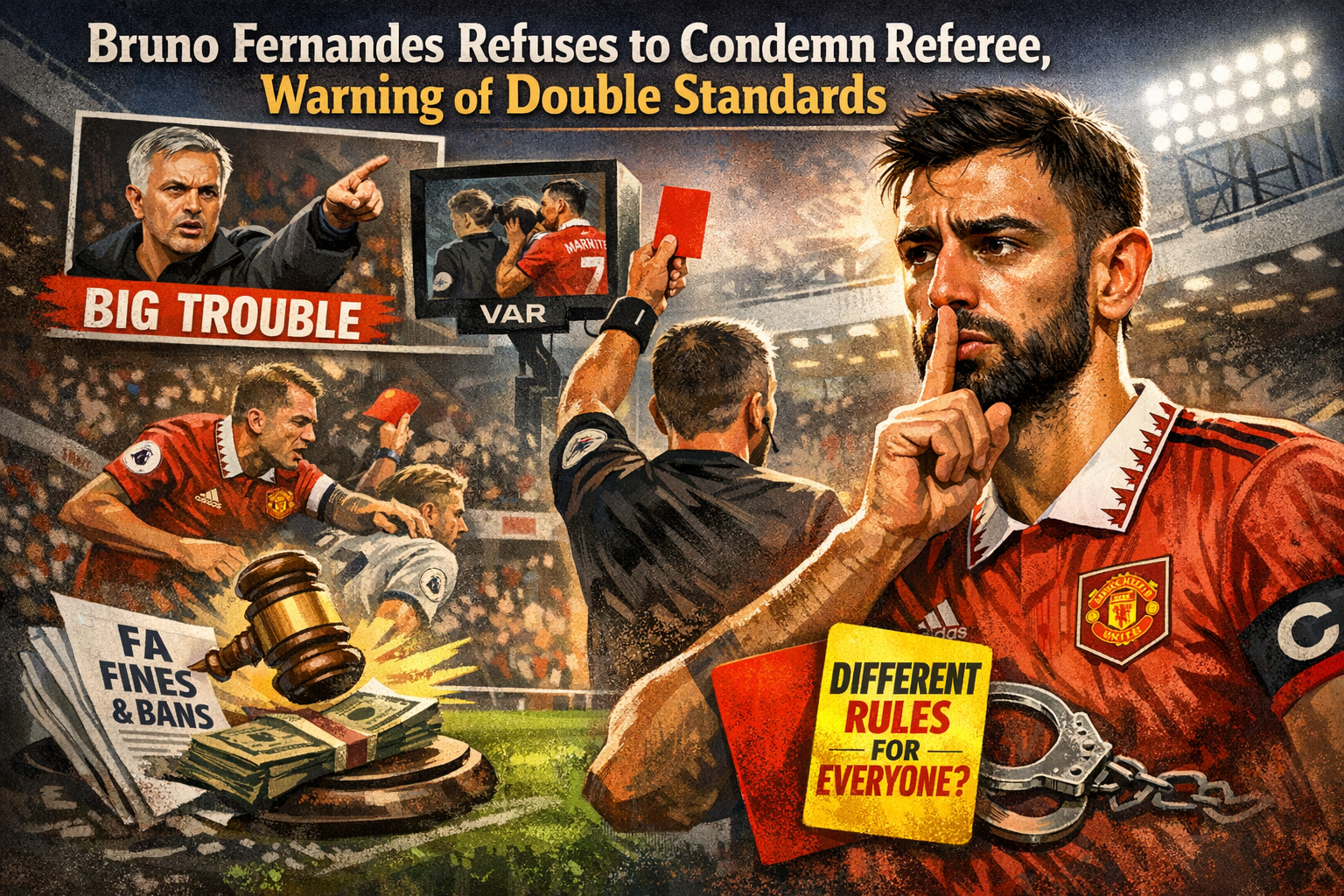
Manchester United captain Bruno Fernandes chose silence over censure after his side fell to a 2-1 home defeat against Leeds United on Wednesday evening, deliberately withholding his opinion on referee Paul Tierney's performance in a calculated act of public restraint. The decision to send off Lisandro Martinez via VAR review — for a hair-pull on Dominic Calvert-Lewin — reduced the hosts to ten men for the bulk of the second half and proved decisive. Fernandes, visibly incensed at full time, made clear that speaking freely would carry consequences he was not prepared to accept.
A Deliberate Echo With Historical Weight
The framing of Fernandes' post-match comments was unmistakable to anyone with a long memory of English football's more theatrical moments in media relations. His phrasing — "I'm not talking about the referee. If I talk about the referee I'm going to get in very big trouble because the rules are different for everyone" — was a near-verbatim callback to José Mourinho's now-iconic 2014 television interview following a defeat at Aston Villa. On that occasion, the then-Chelsea manager deployed almost identical language, repeating the phrase "in big trouble" to signal the absurdity of a system that punishes candour.
Whether conscious or not, the parallel carries real meaning. It reflects a persistent frustration among senior figures in English professional football that the regulatory framework governing public comment on officials creates an inherently unequal situation: players and managers are expected to absorb decisions without rebuttal, while officials face no equivalent public accountability. Fernandes' reference to "different rules for everyone" and discrepancies in yellow card distribution suggests his grievance extended well beyond the dismissal of Martinez alone.
The Regulatory Architecture Behind the Restraint
The English Football Association's rules on media conduct are explicit and long-standing. Criticism of match officials — particularly any comment that could be interpreted as bringing the game into disrepute or implying bias — carries the risk of formal disciplinary proceedings, financial sanctions, and in repeat cases, suspension. This creates a structural asymmetry: the very people closest to officiating decisions, with the most information about how a contest was handled, are systematically disincentivised from commenting in any substantive way.
The result is a familiar genre of post-match television interview — carefully hedged, studiously incomplete — that satisfies neither journalist nor viewer. Fernandes did not simply refuse to answer. He explained, in unusually transparent terms, exactly why he was refusing, which paradoxically communicated his position more effectively than any direct accusation could have. It is a technique that has become its own form of public statement, and one that the FA's rules have no practical mechanism to sanction.
A Suspension That Arrives at the Worst Possible Moment
Beyond the communicative drama, United now face an immediate and concrete problem. Martinez, one of the most physically imposing central defenders in the Premier League, will be unavailable for the visit to Stamford Bridge on Saturday to face Chelsea. Depending on the length of his suspension — automatic bans for violent conduct typically run to three fixtures — he could also miss subsequent fixtures against Brentford and Liverpool, a cluster of demanding opponents that will define the shape of the final weeks of the season.
United currently hold third place, seven points ahead of Chelsea in sixth. With five Champions League qualification positions potentially available this season — the fifth accessible via the European Performance pathway — the cushion is meaningful but not comfortable. Losing a key defensive figure to suspension during a congested run-in is a significant administrative and tactical problem, entirely separate from the question of whether the original decision was correct. That is the practical cost of a moment that lasted seconds and will reverberate for weeks.
What Accountability in Officiating Actually Requires
The deeper question Fernandes' carefully chosen words raise is one that English football has struggled to answer for decades: how should officiating decisions be scrutinised in a sport where the officials themselves operate with near-total immunity from public critique? VAR was introduced precisely to reduce the incidence of high-stakes errors, yet its application — particularly in cases of violent conduct where intent and force are matters of interpretation — continues to generate outcomes that divide opinion sharply.
Paul Tierney's record in fixtures involving United has become a point of particular sensitivity among supporters, though correlation in such a small sample carries limited evidential weight. What is more structurally significant is that no formal mechanism exists for clubs or individuals to publicly contest the reasoning behind a decision without risking punishment. Fernandes chose the only route available to him: conspicuous, pointed silence that said everything he was forbidden from saying directly. Whether the authorities find a way to interpret that silence as a violation will itself be revealing.